Product
Roller blinds
One fabric panel, one clean line, cut to the millimetre for your opening. In a precinct built out of glass, that restraint is exactly the point.
What a roller blind has to do fourteen floors up
Sandown flats don't have windows so much as walls that happen to be glass. The developers built the precinct around the outlook — Sandton's towers to the east, the M1 ridge to the west — and left the shading problem to whoever moved in. A roller blind answers it with the least possible fuss. Fabric wraps an aluminium tube at the head of the opening; pull it down when the afternoon arrives, and it vanishes back into a slim roll the moment you don't need it. Nothing competes with the view, because most of the day there's nothing there at all.
Choose the fabric by the room, not the swatch book
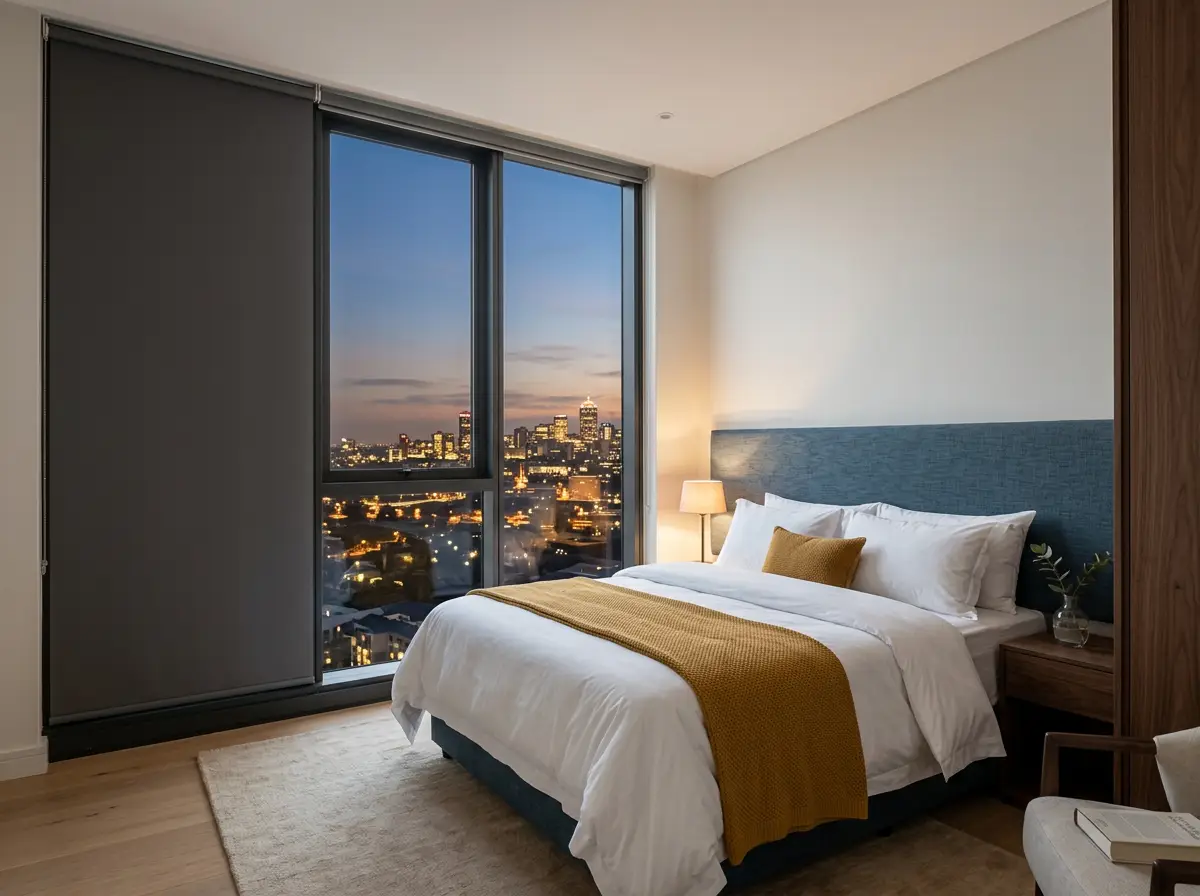
Bedrooms. Sandton never fully switches off at night — tower signage, street lighting, the odd office floor burning late. Blockout fabric is the honest fix. It stops light completely, and on a pane this size it doubles as a modest insulation layer, summer and winter both.
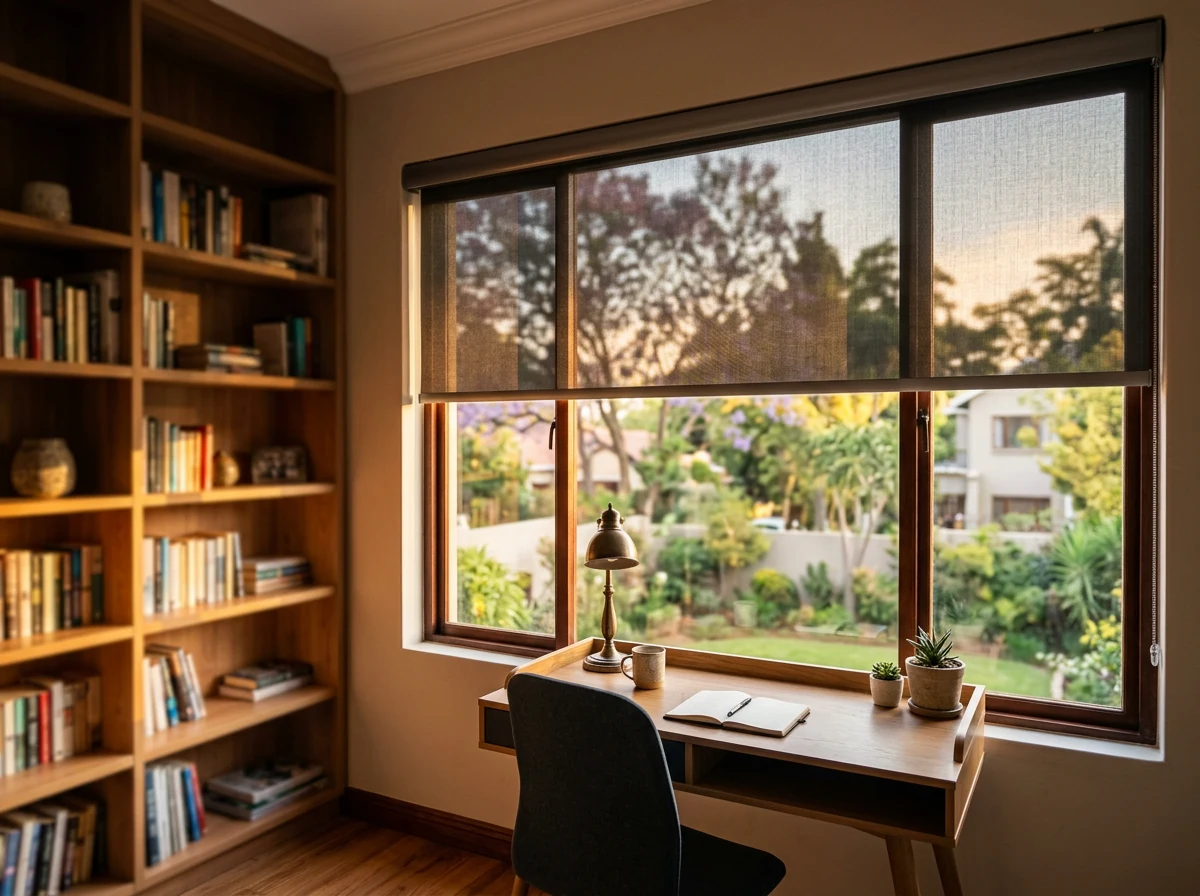
The lounge with the view. Sunscreen mesh is what most of our Sandown measures end up specifying here. The weave is rated by openness — 3%, 5% or 10% — and the number tells you how much of the weave is open hole. Tighter weave, less glare, less heat, slightly dimmer view. On west glass that catches the full three-o'clock sun we rarely go above 5%.
One caution on sunscreen. Its privacy works in daylight and reverses after dark. Lamps on, curtains of night outside, and the block opposite can see in. Bedrooms with sunscreen need a blockout layer too — which is why the double roller exists.
A double roller puts blockout and sunscreen on a single bracket set, stacked one behind the other. Daytime: mesh down, skyline intact. Bedtime: blockout down, room properly dark. One frame, no fighting hardware — and only slightly more than two singles.
Small decisions that decide the finish
The quote will ask about a few details worth understanding in advance. Chain-operated blinds get a tensioner fixing the loop to the wall on every install we do — with children or pets in the flat this is not a preference, it's the rule. A cassette or pelmet hides the rolled tube and can be colour-matched to your aluminium frames, which is what makes a retrofit look factory-fitted. And width has a ceiling: past roughly three metres of fabric a single blind needs either a join line or a linked, motorised pair — a real consideration for the wide sliders that open Sandown balconies to the living room.
Where it wins, where it doesn't
On modern square openings and big panes, a roller blind is close to unbeatable — simple to live with, easy to wipe down, priced from entry fabrics up to wide-width motorised systems. It's the wrong tool for a very wide unbroken span you refuse to join, and in an older Hurlingham-style room with timber frames and deep reveals, a timber venetian usually flatters the architecture more than a flat panel of fabric will.
We measure for rollers across the whole fringe: Morningside clusters, Illovo apartment blocks, Rivonia townhouse complexes and the renovated garden homes of Hurlingham.
Asked at nearly every Sandown measure
Will a sunscreen roller stop my furniture fading?
It helps a great deal — the mesh cuts most of the UV that does the damage — but no fabric stops it entirely. On a west-facing lounge we'd suggest 3% openness and honest expectations: the couch will age slower, not never.
Can one blind cover the sliding door and stay usable?
Up to about three metres of fabric width, yes. Beyond that we'd propose a linked motorised pair or an accepted centre join — the measure visit is where we confirm which your opening needs, in writing.
Inside the reveal or on the wall face — which mounts better?
Inside the reveal looks cleaner and suits most Sandown aluminium openings; face-fixing covers the frame entirely and blocks more light spill. We check squareness, handle clearance and curtain history at the measure and recommend per window.
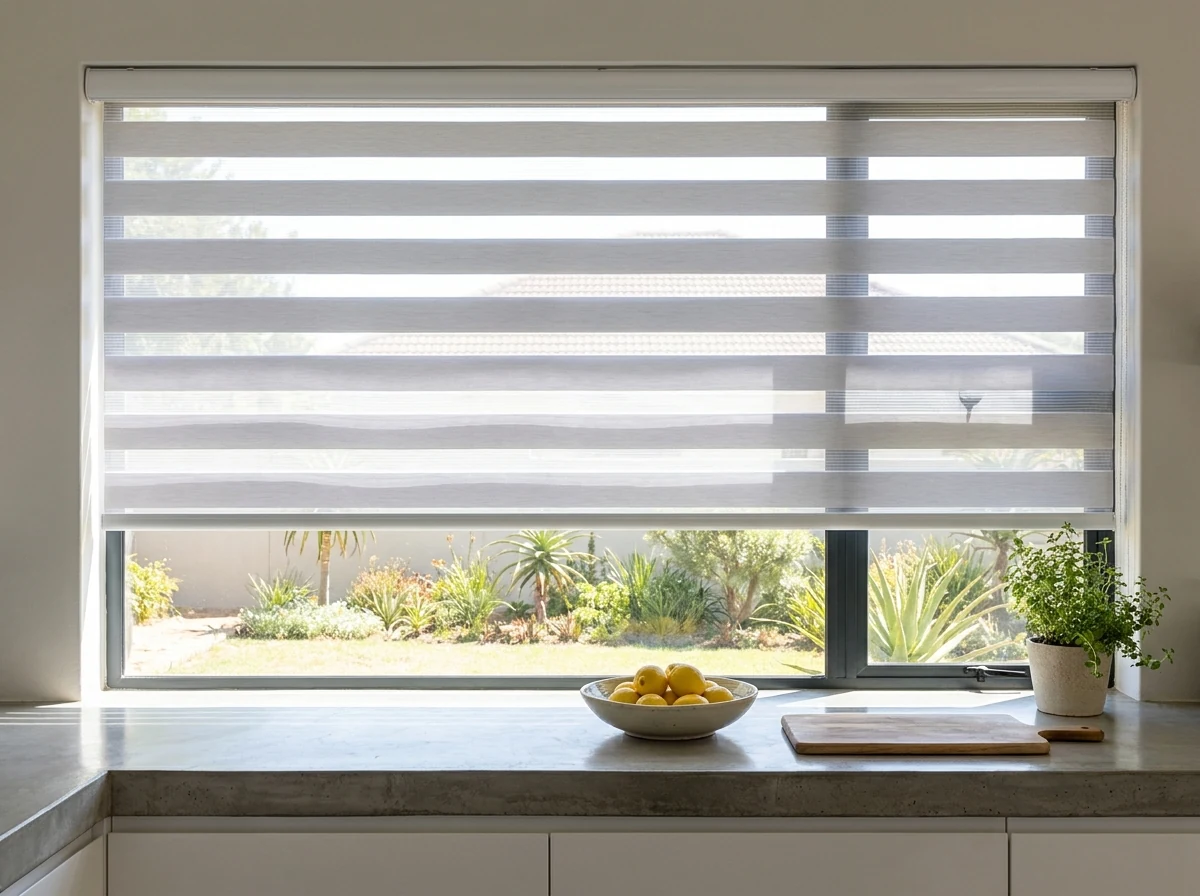
Day/night blinds
Filtered light and privacy in one continuous band.
Motorised & automation
One app, every roller in the apartment.
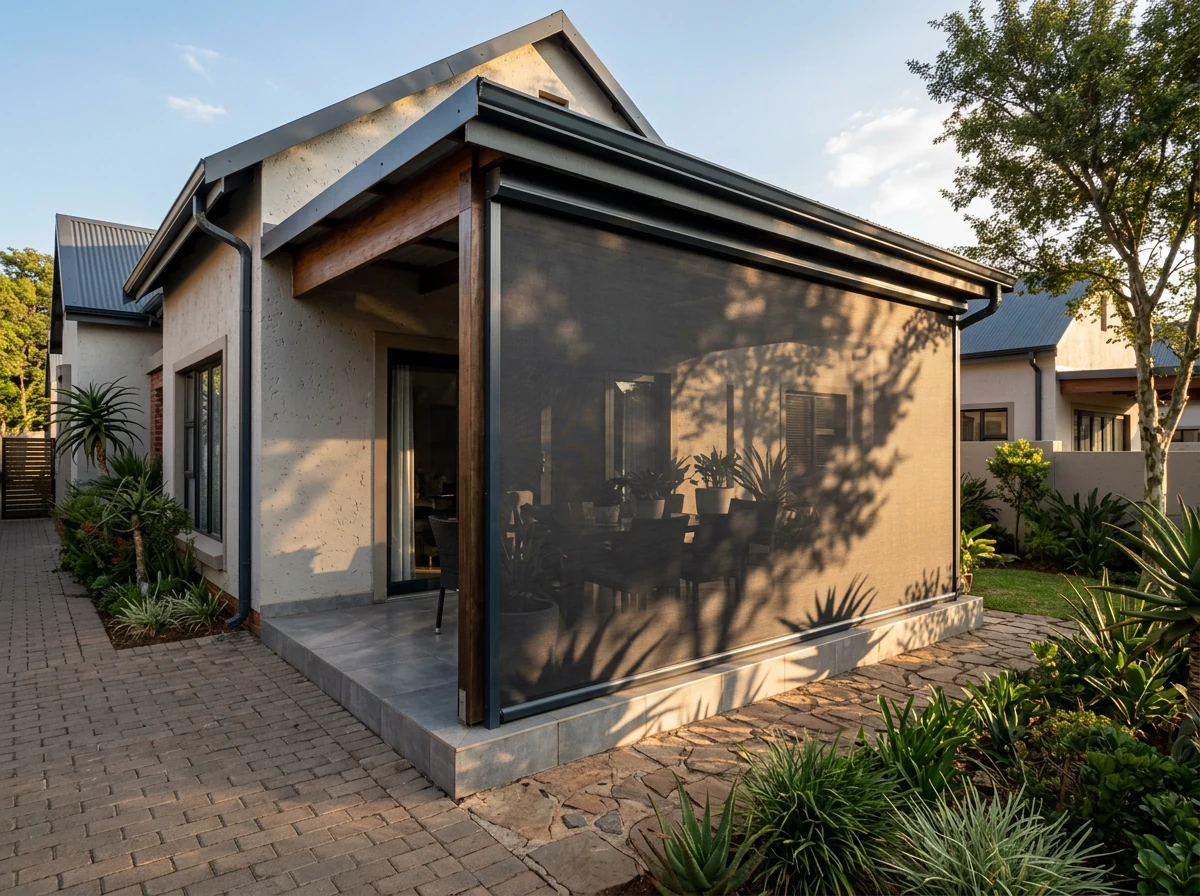
Zip screens
The balcony's answer to the tower wind.
What a roller blind costs in Sandown
Per square metre installed, a roller on a hand chain, whether blockout, sunscreen mesh or a translucent weave, runs about R1,000 to R1,600 per square metre. Ordinary blockout holds the bottom; a close-woven sunscreen of that; a low-openness sunscreen for a west-facing wall of glass, or a stacked pair of cloths on a shared headrail, sits at the upper. Motorised, the band shifts to R2,500 through to R3,800 the square metre, drive, control and commissioning included.
Read them as a planning guide; they are not a quotation. A floor price applies to the small ones, since brackets, tube and fitting time hardly shift with the size of the pane. Every window in the flat is costed on its own at the measure and put in writing.